Why Coated Rubber Timing Belts Outperform Standard Belts in Contaminated or Chemically Exposed Environments
The decision to use a coated timing belt rather than a standard one rarely comes from a product brochure. It usually comes after a standard belt has been replaced two or three times in the same application, someone finally looks at the failure mode closely enough to understand what’s actually happening, and the conclusion is that the base rubber compound isn’t suited for what the drive is running through.
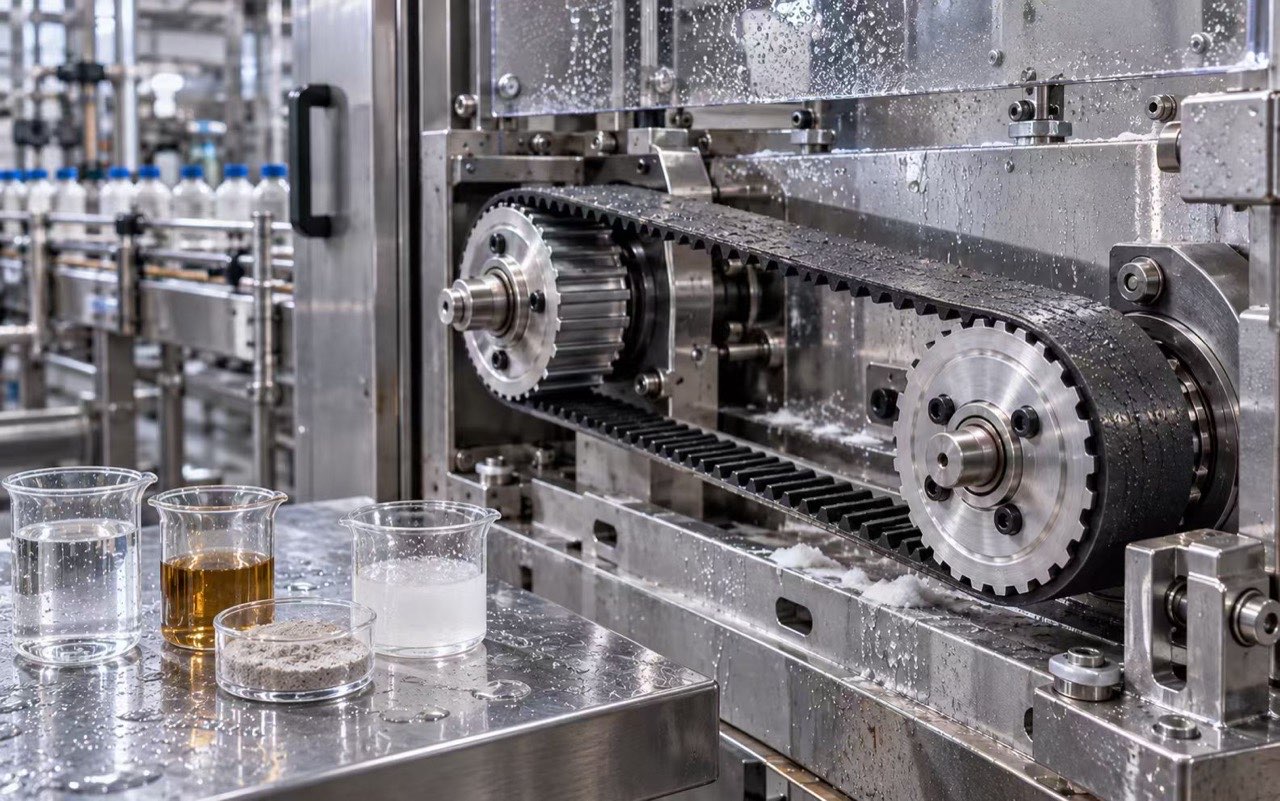
Contamination and chemical exposure cover a wide range of conditions. Some are obvious: a belt running in a chemical plant where cleaning solvents are sprayed routinely, or a belt in a mining environment where the drive is caked in fine abrasive dust and occasional water. Others are less intuitive: a packaging line where lubricants from adjacent machinery migrate onto the belt, or a food processing environment where daily washdowns with caustic cleaners attack the belt surface over time. The common thread is that the environment does work on the belt that the tooth-meshing load alone doesn’t account for, and standard rubber compound isn’t designed to resist that work.
What a Coating Actually Does
The rubber in a standard timing belt is formulated for flex fatigue resistance, temperature range, and dimensional stability under load. It’s not formulated to resist surface chemical attack, abrasion from particulate contamination, or the water absorption that can cause swelling in high-humidity environments. The surface properties of the belt — how it responds to contact with external substances — are whatever the base compound produces, which isn’t usually the design priority.
A coating adds a layer with different surface properties over the base compound. Depending on the coating material, this can mean better resistance to specific chemicals, reduced abrasion from particles, reduced friction against guide rails, or protection against moisture penetration. The coating handles the environmental exposure; the base compound handles the mechanical requirements. The two functions are separated so each material can be optimized for what it actually does.
Polyurethane coatings are common in applications where abrasion resistance is the primary concern — drives that run through fine particulate, where the belt surface would otherwise wear unevenly and affect pitch accuracy over time. PTFE-based coatings appear in applications involving lubricant exposure or where low surface friction is needed to prevent material buildup on the belt. Fabric coatings, typically nylon or polyamide, show up in applications where the belt contacts product directly and the tooth-side surface needs to carry items smoothly without damaging them. Each of these addresses a specific environmental condition that the base rubber compound handles poorly on its own.
Chemical Resistance and Why It’s Not Universal
It’s worth being direct about what chemical resistance means in practice: it’s always specific to particular chemicals and concentrations, not a blanket property. A coating that performs well in petroleum-based lubricant exposure may not hold up in acidic cleaning agents. A coating selected for caustic wash environments may not be appropriate for solvents. The relevant question when specifying a coated belt is not “is it chemical resistant?” but “is it resistant to these specific chemicals at these concentrations and exposure frequencies?”
Applications that get this wrong typically select a coated belt over a standard one, see some improvement, and then still encounter premature degradation because the coating wasn’t matched to the actual contaminant. The failure mode shifts — it may look different from what was happening with the standard belt — but it’s still a materials mismatch problem rather than a maintenance problem.
Getting it right requires identifying the specific substances the belt will contact, how often and in what concentrations, and whether the exposure is incidental (occasional splash, periodic washdown) or continuous (the belt runs through a wash system). With that information, a belt manufacturer can specify the appropriate coating and confirm resistance data for the relevant chemicals. Without it, coating selection becomes a guess with only a marginally better probability of success than using standard rubber.
Abrasive Environments and Surface Wear
Chemical attack and abrasion produce different failure signatures, but both involve surface degradation that eventually compromises tooth geometry. In abrasive environments — cement plants, quarries, mineral processing, certain agricultural applications — the primary concern is that particulate contamination works against the belt surface with every rotation. On a standard rubber belt, this gradually erodes the tooth profile. The belt continues to function until the tooth engagement is poor enough that it skips under load, at which point the failure appears sudden even though it was accumulating over months.
A harder coating surface — polyurethane or certain fabric types — resists this erosion significantly better than the base rubber. The differential in wear rate between a coated and an uncoated belt in a high-abrasion environment is often substantial enough to justify the cost difference on replacement frequency alone, before accounting for the downtime cost of belt failure and the time cost of replacement in a difficult-to-access drive location.
The coating doesn’t make the belt immune to abrasion. It extends the period before surface degradation reaches the point where tooth geometry is compromised. In environments with very heavy abrasive loading, even a coated belt will require eventual replacement; the question is whether the interval is acceptable for the application or whether additional environmental controls are needed to protect the drive.
Humidity, Washdowns, and Water Exposure
Water and high-humidity environments affect timing belts through two mechanisms. Direct chemical attack is less common with water than with other substances, but the absorption of water into the rubber compound can cause dimensional changes — swelling — that affect pitch accuracy and tooth engagement. Repeated wet-dry cycles can accelerate surface cracking in compounds not designed for it.
Washdown environments introduce a secondary concern: the cleaning agents used in the washdown are often more aggressive than the water itself. Caustic cleaning compounds, disinfectants, and certain sanitizing agents can attack rubber compounds at rates that produce visible surface degradation within months in a frequent-washdown environment. Food processing facilities that wash down daily with high-pH cleaners see this consistently with standard rubber belts.
Coatings for these environments are selected for both water resistance and compatibility with the specific cleaning chemistry. The belt tooth contact surfaces need to maintain their geometry through repeated chemical exposure; a coating that would degrade from the cleaning agent provides no protection even if it handles water well. This is another area where specifying to the actual environment rather than to a general “chemical resistance” claim matters for outcomes.
How the Decision Should Be Made
The practical starting point is a clear description of the environment: what contaminants are present, what cleaning procedures are used, what the temperature range is, and what the drive demands are in terms of load and speed. From that description, the appropriate coating type can be identified. A Coated Rubber Timing Belt matched to the specific environmental conditions will outperform a standard belt in contaminated or chemically exposed applications — not because coated belts are inherently superior, but because the coating is doing specific protective work that the base compound cannot.
The alternative — selecting on price and replacing more often — has a total cost that most buyers underestimate. Replacement cost, labor, downtime, and the risk of unplanned failure in a drive that’s running contaminated machinery all factor in. Running the numbers on a specific application usually makes the case for appropriate coating selection more clearly than any product comparison.